Engineering a High-Throughput Asset Tracking Engine: Architecture, Hardware, and Enterprise Integration
How logistics teams can combine barcode, RFID, BLE and GPS data with event processing and ERP integration to track assets at scale.
Key takeaways
- 1Choose capture hardware according to range, cost, environment and workflow.
- 2Use queues, idempotency and clear data ownership to handle telemetry and ERP handovers.
- 3Separate ingestion from processing so traffic bursts do not block device connections.
- Published on
Topics


On this page
Managing thousands of high-value pallets, reusable containers, industrial machinery or other inventory across international supply chains becomes difficult without real-time tracking. When logistics operations rely on manual logs or disconnected spreadsheets, missing assets, costly turnaround delays and hidden supply-chain bottlenecks can become accepted operating costs.
At Direct Software, we build custom logistics asset tracking engines to ingest frequent telemetry, reconcile physical movements with enterprise resource planning (ERP) systems and scale without downtime.
1. Why spreadsheet-based tracking creates friction
Static spreadsheets, manual batch exports and local desktop tools create operational drag when people use them to manage assets across sites and supply chains:
- Unaccounted-for assets and replacement spending. Containers, returnable packaging and equipment can disappear into carrier networks without a recorded handover. Companies may over-purchase replacement stock by 15% to 30% to buffer against unaccounted physical shrinkage.
- Longer cycle and turnaround times. Assets left at third-party logistics (3PL) hubs or customer facilities can sit unnoticed. Without current location data, asset velocity falls and businesses may maintain larger inventory buffers.
- Separate physical and financial records. Manual tracking disconnects location data from financial ledgers. Billing teams may delay rental invoices or miss lost-asset penalties when physical handovers were not recorded in the ERP system.
“If asset tracking depends on a human remembering to update a cell at the end of a shift, your data is already out of date. Custom tracking engines eliminate human error by capturing movement automatically at the moment of physical transfer.”
— Brian Timmermans, Technical Lead at Direct Software
2. A three-layer architecture for asset tracking
A resilient tracking engine separates physical data collection from core business processing. We build around a strict three-layer telemetry stack: device and IoT ingestion, a central API processing engine, and web and mobile applications connected to business systems.
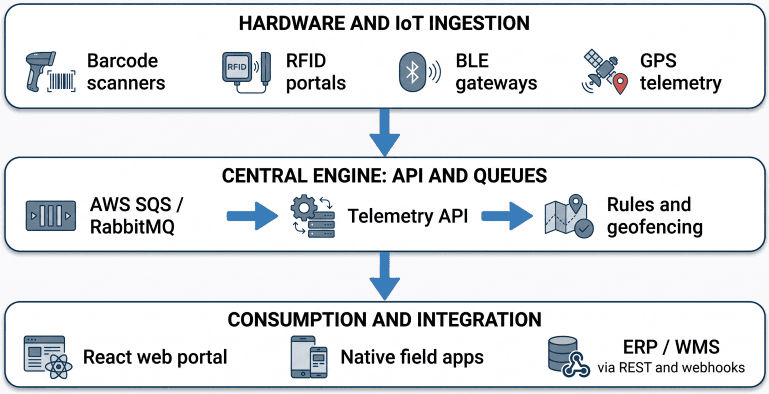
The hardware and IoT ingestion layer captures physical events with fixed scanners, handheld devices, RFID portals or GPS and Bluetooth Low Energy (BLE) gateways. It structures them as lightweight JSON events and sends them over HTTPS, MQTT or CoAP.
The central processing API receives telemetry, validates hardware signatures, applies business rules, evaluates geofences and stores historical location trails in persistent databases.
The web portal and mobile field apps provide role-based dashboards, maps, chain-of-custody records and offline-first tools for dock workers and field teams.
3. Choosing between barcodes, RFID, BLE and GPS
The right identification technology depends on tag cost, reading distance, facility conditions and how quickly assets need to be recorded.
| Technology | Reading range | Unit cost | Line of sight? | Suitable use |
|---|---|---|---|---|
| 1D / 2D barcodes and QR codes | Touch to 1.5 m | Less than US$0.01 | Yes; manual point scan | Low-cost items, box labels and manual warehouse checkpoints |
| Passive RFID (UHF) | Up to 12 m | US$0.05–0.30 | No; bulk gate scanning | High-volume pallet tracking, automated loading docks and garment logistics |
| Active BLE beacons | Up to 100 m | US$5.00–20.00 | No; continuous indoor telemetry | Yard management, indoor machinery location and temperature-sensitive cold chains |
| Cellular GPS trackers | Global | US$30.00–150.00 | No; satellite or cellular connection | High-value sea and rail containers, heavy equipment fleets and cross-border transit |
4. Connecting asset movements to ERP and WMS systems
An asset tracking platform creates more value when it connects to existing infrastructure, such as SAP, Microsoft Dynamics 365, Oracle or a warehouse management system (WMS).
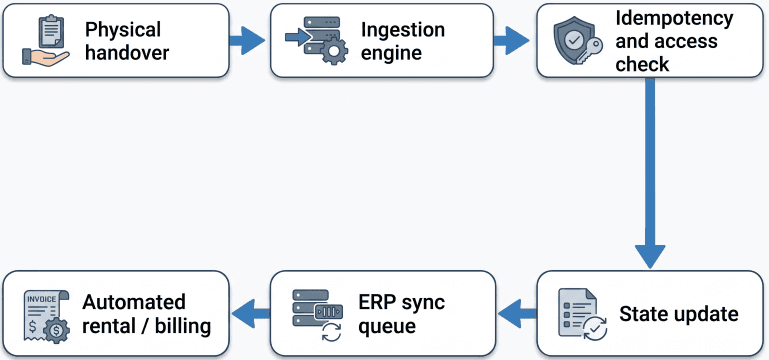
- Automated rental cycles and inventory reconciliation. When an RFID tag passes an outbound dock portal, the engine can notify the ERP to start rental calculations, update stock locations and trigger delivery manifests.
- Two-way synchronisation through webhooks and event streams. Changes to shipping orders in the ERP update tracking rules, so scans at field depots immediately match active customer accounts.
- Idempotency and duplicate handling. Edge scanners may report the same container more than once within seconds. We use transactional idempotency keys at the API gateway to prevent duplicate ledger transactions or incorrect billing updates.
Custom enterprise connectors
We build integration middleware for SAP, Microsoft Dynamics 365 and proprietary databases without requiring an expensive third-party platform overhaul. By processing data transformations in lightweight microservices, we ensure 100% synchronisation reliability with zero middleware latency.
For a broader guide to planning system handovers, see how to connect business systems without replacing everything. Learn more about our system integration expertise.
5. Geofencing, alerts and anomaly detection
Rules engines turn location data into operational signals:
- Geofences and boundary departures. Define areas around yards, customer sites and transit corridors. The engine evaluates coordinates in real time and can notify teams when assets leave authorised zones.
- Dwell time and stagnation. Alert when assets remain still beyond expected processing windows, helping yard managers investigate possible bottlenecks.
- Maintenance and lifecycle schedules. Use distance travelled, operating hours and temperature excursions to schedule preventive maintenance before equipment fails in the field.
6. Scaling high-throughput event ingestion
Peak logistics operations can generate thousands of telemetry events per minute. A monolithic, synchronous database design will fail under these loads. We use cloud-native event-streaming architectures for high throughput and fault tolerance.

- Asynchronous queues (AWS SQS or RabbitMQ). Incoming payloads enter highly available message brokers. The buffer isolates ingestion endpoints from database latency spikes and prevents dropped telemetry packets.
- Stateless microservices. Scalable workers pull events from queues, evaluate locations and geofences, and append records without blocking incoming connections.
- Time-series and spatial databases. We structure data with time-series partitioning, such as PostgreSQL with TimescaleDB, or spatial indexing in MongoDB. This maintains sub-second query performance across tens of millions of historical location records.
Why logistics teams partner with Direct Software
- Custom intellectual property and code ownership. No ongoing per-tag, per-asset or per-user SaaS vendor licensing fees.
- Purpose-built scalability. Cloud-native architecture designed from day one to handle millions of telemetry updates with sub-second response times.
- Enterprise compatibility. Native integration with existing SAP, Dynamics 365 and proprietary supply-chain ecosystems.
Moving from manual tracking to an automated, scalable asset tracking engine reduces loss rates, speeds up turnaround times and provides clear visibility across the supply-chain network. At Direct Software, we partner with logistics operators and enterprise teams to design, architect and build custom tracking software for their operational needs.